
Tumbler Sizes: B2B Capacity and Assortment Guide
Tumbler sizes should be selected as an assortment architecture, not as a list of ounce labels. A B2B buyer needs usable capacity, dimensions, full weight, lid and handle configuration, user role, holder fit, packaging, artwork, testing, and evidence for each exact model.
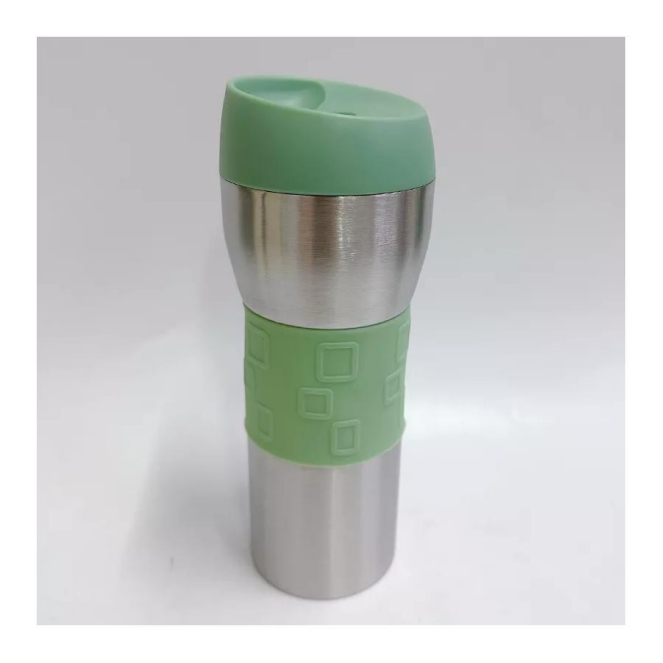
Stainless steel coffee tumbler with green silicone grip sleeve and sip lid
This article focuses on tumbler size roles, distinct from water bottle geometry comparison and capacity-data definitions. DIZHOU's insulated tumbler example provides product context, while every measurement and claim remains model-specific.
Use the insulated tumbler product example as one size-and-component reference, then verify the complete assortment at model level.
What Do Tumbler Sizes Need to Accomplish?
Define the user, beverage, refill interval, drinking mode, carrying position, holder, desk or bag setting, channel, and price-position inputs without assuming one size fits every program.
Assign each proposed size a distinct job. Remove near-duplicates that add files and inventory without serving a new user task.
Separate Nominal Capacity From Usable Fill
Record declared capacity, usable fill, fill method, headspace, lid state, unit conversion, and rounding rule. Use the approved specification and identified sample.
Do not compare a rounded label from one model with a measured fill from another as if the values were equivalent.
Build Program-Defined Size Roles
Use internal bands such as compact, standard, and high-capacity only as decision aids. The actual measured values and exact configurations remain the source of truth.
The table below connects each role with its decision question rather than inventing universal market ranges.
Write a one-sentence job for every retained size, naming the user, beverage, refill interval, carrying setting, lid mode, and channel. If two jobs are materially the same, reconsider whether both sizes belong in the active assortment.
Use demand and operational evidence where available, but do not create a size solely to make the range look complete. A smaller, clearer architecture can reduce samples, artwork, packaging, and support complexity.
Size role | Primary program question | Trade-off to validate | Required record |
Compact | Does portability outweigh refill frequency? | Lower volume versus smaller envelope | Usable fill, full weight, geometry, fit |
Standard | Does one configuration serve the main user? | Broad fit versus limited specialization | Journey test, lid, care, package |
High-capacity | Is longer refill interval worth added burden? | More volume versus weight and footprint | Filled handling, holder, carton, evidence |
Measure Geometry and Full Weight
Capture height, base, widest diameter, opening, handle envelope, lid projection, empty weight, and filled weight. Note whether accessories are included.
Compare balance, grip, and drinking angle with the intended fill. Equal capacities can behave differently because of taper, handle, lid, and wall construction.
Record the drawing revision, measurement source, sample identity, method, and date beside each value. Do not combine dimensions from a drawing with weight from a different prototype without marking the mismatch.
Measure the complete decorated unit again when coating, handle, lid, straw, boot, or accessory changes the external envelope. These changes can affect holder clearance, packaging inserts, and product photography.
For measurement and change control, reference DIZHOU's manufacturing and inspection information and align drawings, samples, inspections, and packed units.
Check Lid, Straw, Handle, and Holder Fit
Test the complete production configuration against measured holder, shelf, bag, and equipment constraints. Include the lid opening path and handle clearance.
Record observed fit and movement rather than claiming compatibility with most holders or environments.
Connect Size to Cleaning and User Burden
Larger bodies and complex lids can change brush reach, sink fit, drying, component count, and reassembly. Smaller openings can change filling and inspection.
Use the exact model's instructions and test the ordinary care workflow with the approved lid and accessories.
Plan Packaging and Artwork Across Sizes
Each size can change print area, logo scale, box, insert, carton, labels, instructions, and product photography. Decide which assets are shared and which require separate approval.
Retain a decorated packed sample for every materially different configuration and link it to the size matrix.
Control the Tumbler Assortment Matrix
Maintain SKU, role, capacity, usable fill, dimensions, weight, lid, straw, handle, materials, finish, artwork, package, evidence, sample, and approval date in one controlled record.
When a size or component changes, reopen the affected fit, care, package, and public-content checks rather than editing a label alone.
Add status, owner, record origin, revision, replacement relationship, and retirement rule so the matrix distinguishes current, proposed, superseded, and archived configurations. Do not delete old references needed to explain a published page or retained sample.
Check that titles, slugs, descriptions, labels, and sales sheets use the approved size name consistently while still presenting exact ounces and milliliters according to the controlled conversion rule.
Before launch, reconcile the matrix with the physical samples and packed units. A correct spreadsheet does not cure a mismatched lid, wrong insert, or outdated instruction in the final carton.
Validate the Size Architecture With Real Scenarios
Run each candidate through its intended journey and compare refills, full-weight handling, holder fit, drinking, cleaning, shelf or gift presentation, and packed footprint.
Document why each size remains, changes role, or is rejected. This prevents the assortment from expanding without evidence of a distinct task.
Prepare a Tumbler Size RFQ
Provide user roles; nominal and usable capacities; dimensions and full weights; lid, straw, handle, and wall construction; holder constraints; care; artwork; package; target market; evidence; and sample methods.
This makes tumbler sizes an auditable assortment decision rather than a collection of familiar ounce labels. Include the role and rejection reason for each candidate so later assortment reviews begin with the approved logic instead of repeating the same debate. Keep proposed and retired configurations visible in the history.
Conclusion
Tumbler sizes work as a portfolio only when every capacity has a distinct user role and a verified record for usable fill, geometry, full weight, components, fit, care, artwork, package, and evidence. To plan an assortment, send your tumbler size requirements to DIZHOU with the user scenarios, configurations, tests, market, and approval criteria.

