


Coffee Tumbler Best Practices for B2B Product Programs
A coffee tumbler best suited to a B2B program is not defined by one capacity or a fashionable silhouette. It is the tumbler whose body, insulation, lid, seals, handling, cleaning, decoration, packaging, and evidence match the intended user journey and can be controlled during production.
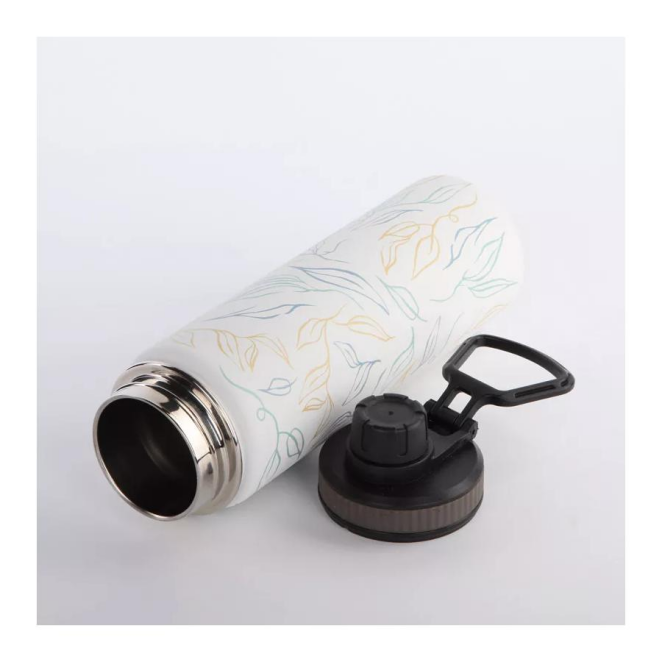
White leaf-print 20oz double-walled stainless steel water bottle lying with sport lid
DIZHOU currently presents insulated tumblers, handled large-capacity cups, skinny and printed tumblers, coffee mugs, and travel mugs. These product families create options, but exact wall construction, materials, closure behavior, and performance must remain model-specific.
For an example of the relevant product context, review the 40 oz insulated tumbler example before finalizing the specification.
What Makes a Coffee Tumbler Best for a B2B Program?
Define the program before choosing the tumbler: desk coffee, commuting, vehicle use, gifting, retail, events, or fitness crossover. Record the serving volume, drinking time, carrying position, refill pattern, and cleaning expectation.
The intended channel also affects decoration, packaging, labeling, and the amount of product education needed. A gift program and a daily commuter program may use similar shapes but require different approval criteria.
Select Capacity, Footprint, and Handle Strategy
Specify usable capacity, height, diameter, base, full weight, center of gravity, and cup-holder or bag constraints. A handle can improve carrying for some users but adds geometry, packing volume, and decoration limitations.
Test retrieval, grip, drinking angle, and stability with the tumbler full. Check whether the handle or body interferes with holders, packaging, or adjacent products on a retail shelf.
Define Insulation as a Measurable Requirement
Do not use insulated as a substitute for a construction specification. Identify wall structure, materials, lid state, and the agreed thermal method. Starting temperature, fill, ambient conditions, duration, and measurement points must be consistent across samples.
Avoid copying a retention number from another model. The public page can show that insulated products exist, but a claim should be tied to the approved SKU and test record.
Treat Lid, Straw, and Seal as One Closure System
Straw lids, sipping openings, plugs, sliders, gaskets, and vents change flow, splash behavior, cleaning, and the number of components. Specify how the user drinks and whether the product is carried upright or exposed to movement.
Test repeated closure cycles, orientation, movement, and cleaning. Record the exact seal and lid version used in the approved sample so substitutions trigger review.
Buyers can also review DIZHOU's drinkware customization and production services to understand the current public capability boundary.
Inspect Finish and Decoration Under Use
Powder coating, paint, printing, and other finishes interact with grip, color tolerance, abrasion, and artwork placement. Compare decorated samples under the intended handling conditions and define measurable cosmetic acceptance.
DIZHOU presents logo, color, finish, and packaging customization. The buyer should approve the body, handle, lid, straw, decoration, instructions, and packed unit together.
Build a Production-Control Package
The approved package should include drawings, materials, component list, color reference, artwork, test methods, packaging specification, photographs, and retained samples. Identify incoming, in-process, finished-product, and packed-unit checks.
A change to a lid, gasket, handle, coating, or package may affect function or evidence even when the product name remains the same. Use revision control instead of accepting silent substitutions.
Insulated Tumbler RFQ Checklist
Send the user scenario; usable capacity and dimensions; handle and cup-holder requirements; wall construction and materials; lid, straw, seals, and accessories; insulation and closure tests; finish and artwork; packaging and instructions; target-market evidence; and sample approval method.
These inputs allow a buyer to compare equivalent proposals rather than different interpretations of coffee tumbler best performance.
Validate the Tumbler in Its Intended Environment
Use the approved sample at full capacity in the intended holder, bag, desk, or carrying position. Check grip, handle clearance, base stability, drinking angle, straw reach where applicable, lid retention, and access for cleaning. Repeat the sequence with the actual beverage type planned for the program.
Photograph the setup and record measurable criteria. A vehicle cup-holder test, for example, should identify holder dimensions and the allowed movement. A closure test should identify orientation, duration, liquid condition, and pass criteria. Avoid translating one successful test into an unlimited public promise.
Avoid Common Insulated-Tumbler Approval Gaps
Do not approve a decorated body with a different lid from the functional sample. Do not compare capacity without full weight and dimensions, or select a handle without checking packaging and holder clearance. Do not accept a family-level material or performance statement as the specification for every SKU.
The production reference should cover all components and the packed unit. Identify which measurements and visual features are checked on incoming parts, during assembly, on finished tumblers, and after packing. Keep retained samples and revision-controlled documents available for later questions.
Translate the Approved Tumbler Into Consumer Information
Product content should state only what the approved configuration and evidence can support. Align the capacity, material wording, closure instructions, cleaning limits, included accessories, and intended carrying position across the product page, packaging, and user guide. If the tumbler is designed for upright cup-holder use, do not imply unrestricted bag transport. If insulation was tested under defined conditions, keep the statement connected to that model and method. This disciplined handoff protects the buyer from creating a broader promise than the production standard.
Conclusion
Coffee tumbler best practice is to define the user journey, measurable construction and tests, complete closure system, decoration, packaging, and evidence before selecting a supplier. Approve and retain the full product kit, not only the body. To scope an insulated tumbler program, send your tumbler product and project requirements to DIZHOU without assuming unverified performance or commercial terms.

